FRFabian Roser
AI TRANSFORMATION IN MARKETING

Turning the skill of a few into a model the whole organisation carries.

You're responsible for marketing, in a company or an agency, and you already have people in the building who are genuinely good with AI. I turn that beginning into exactly this model, with a contribution you can measure. From Hamburg across DACH and beyond.

AI transformationCompanies & agenciesAdoptionHamburg · DACH
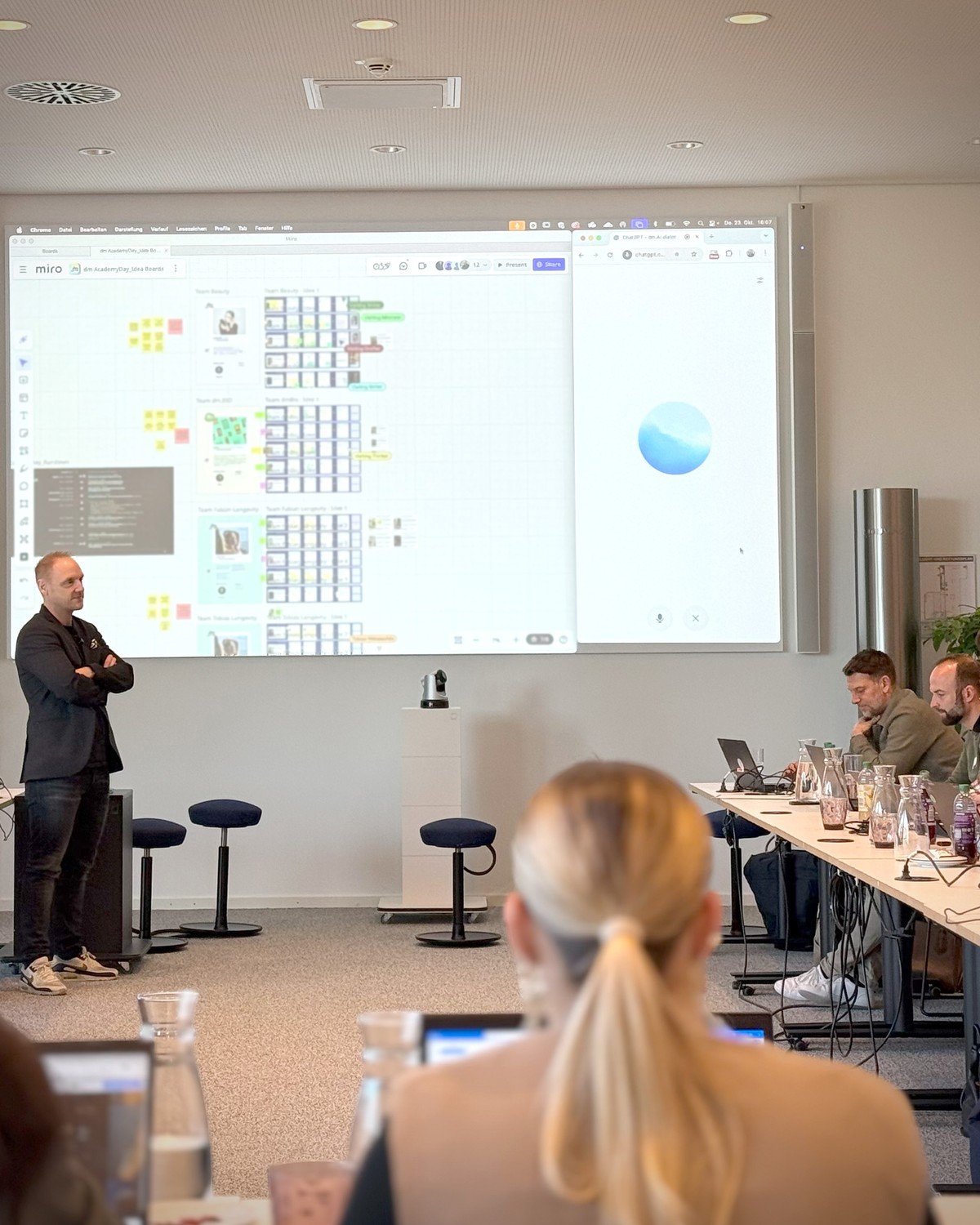
Fabian Roser in an enterprise workshop with a leadership team
Selected agency references
Jung von MattOgilvyDDBantoniDAMMANNWORKSPhilipp und Keuntjewob
Brands I've worked with
dm-drogerie marktDHLJägermeisterNetto Marken-DiscountGebr. HeinemannDeutsche TelekomAudiLufthansa
01The problem

Almost everyone uses AI. Almost no one has it under control.

The agency world was the first to measure itself, which is why the figures come from there. But every marketing organisation knows the pattern behind them, whether agency, in-house studio or marketing department: the skill sits with a few people, on islands. And islands don't scale.

What “advanced” actually means.

What usually runs today
  • Drafting copy. A chatbot delivers a first version, someone rewrites it.
  • Images, moodboards, motion. A model produces material for the presentation.
  • Shortening long documents. Studies, minutes and reports in brief.
  • Translating and proofreading. Faster than before. Otherwise as before.

Single tasks. Everyone for themselves, every time from scratch.

When whole processes are translated
  • Scattered communication becomes a brief. What sits across weeks of mails, attachments and notes turns into a clean brief. Whatever is missing comes back as a ready-to-send follow-up email.
  • The brief becomes campaign routes. Strategy, creative brief and several routes with insight, idea, headline and image emerge in one run. You pick and sharpen: the chain supplies the drafts, the judgement stays with you.
  • The approved idea becomes every asset. Every channel, every format, every language in final quality. What used to be weeks of versioning work runs through while you're already on the next thing.

Three steps, one chain. What comes out of one is what goes into the next.

And you sit at every handover: what moves on, what gets sharpened, what goes back to the start. The chain takes the busywork, not the judgement. The technical term is agentic workflows. In practice it's the difference between using AI and working with AI.

ISLAND KNOWLEDGEOPERATING MODEL
02An honest look

You started long ago.

AI is in the building, as it is in almost every marketing organisation: licences are running, a few people work with it really well, and there are first wins. That's a real start, and it counts. The path from this start to an operating model is the part very few have taken so far. Not through neglect: day-to-day business rarely leaves room for it.

How you can tell you're exactly at this point.

A lot depends on the same two or three people.They're genuinely good, and that's exactly what makes them the bottleneck. Everyone else works as before, or quietly gets by on private accounts: a sign that the official path doesn't carry yet.
Single tasks got faster, but the results barely show it.The gain stays inside the teams and gets absorbed elsewhere, as long as the process around it stays the same.
Nobody can say for certain what it delivers.There's movement, and there are good examples. But without checkpoints, the contribution can neither be steered nor defended in the next budget round.

None of this is a reproach. It's the normal state of play, a year or two in. The difference between organisations is made by what comes next.

03The solution

Impact needs both: system and adoption.

System×Adoption=ImpactSystem built. Adoption anchored.

Most of the market covers only one half: some train without building a system, others build systems nobody uses. I do both, build the system and anchor it in the everyday. I know what that looks like from the inside: the question is on the table, the pitch runs anyway, and there is no space in the calendar for the topic itself. So I don't hand over a concept you then have to implement as well. I do it with you.

What I'm working towards with you.

Your recurring work runs as a chain, not as busywork.Carried through from brief to final asset, with your decisions at every handover. And carried by the whole team, not just the two or three who can.
What AI contributes, you can show, not just sense.With checkpoints instead of good examples. In a company that carries the next budget round; in an agency, AI capability becomes a service clients buy instead of a discount in the next pitch.
Your team comes along, and you can see it.No rollout against the team, but with it. Without fear, with more room for the idea. And in the end the official path is the most convenient one, so nobody needs the workaround any more.

He is one of those who do, who kick things off. A creative leader with a digital heart, always fully committed.

Christoph Pietsch · Chief Growth Officer, Publicis Groupe Germany
04Working together

Let's begin.

Four building blocks that build on each other and continue if you want them to.

01
Block 1 · Entry

Day sprint

1 day

A day that leaves you knowing where you stand and what comes first.

  • Where does the island knowledge sit, and where does adoption stall?
  • Which repetitive work eats margin and could be rebuilt as a workflow?
  • At the end: three operational levers.
1 dayLever 01Lever 02Lever 03Three operational levers, prioritised.
02
Block 2 · Core

The 30-day sprint

30 days

The three levers from the day sprint become a running system.

  • Your key processes made tangible as AI workflows, with the first prototypes built by me
  • A use-case portfolio you can actually decide on, plus a governance baseline
  • A 90-day adoption plan with checkpoints that brings the whole team along, not just the few who can
Top 3–5FeasibilityMargin impact
03
Block 3 · Ongoing

Ongoing advisory

ongoing

An experienced head alongside the leadership team.

  • Fixed sessions each month, plus a quarterly look outward: what is new, what is ready, and what you can safely ignore
  • When it helps, I keep building and implementing myself
  • Keeps adoption moving, makes it measurable and keeps the team on board
2 sessions / monthQuarterly radarA steady rhythm over time.
04
Block 4 · Leadership

AI for executives

1:1 coaching

On your level, confidential, built around your calendar.

  • Build and extend your own AI capability, without having to work it all out on the side
  • Company-wide rollout: enablement and change management
  • Because adoption carries much further across the company when leadership goes first
1:1Your own AI capabilityRollout & enablementChange management

Common questions

Who is the AI consulting for?
For everyone responsible for marketing, in a company as much as in an agency: from the marketing department of a mid-sized company via in-house studios and brand teams in large organisations to advertising, media, digital and corporate-design agencies. Decision-makers at management and leadership level.
We're not an agency but a company with its own marketing. Does this fit?
Yes, with nothing lost in translation. In-house studios and marketing organisations do the same work as agencies, just under a different roof: briefs, campaigns, content, formats. The patterns are the same accordingly, from island knowledge to the question of what AI actually contributes. A large part of my work happens exactly there, in large companies and the Mittelstand.
Our in-house studio is growing right now. Is it too early for an operating model?
The opposite, it's the best moment. When work moves from the agency into the building, the way of working is still malleable: processes can be designed with AI from day one instead of being rebuilt later. That's exactly what the day sprint is for: sorting out once what the studio should be able to do, and how it will deliver it.
Some of our people already work with private AI accounts. Is that a problem?
Above all it's a signal, a good one and a serious one at once. Good, because the motivation is clearly there and nobody needs convincing. Serious, because data protection, quality and know-how bypass the organisation this way. The answer isn't a ban, but an official path that's better than the workaround. Then the shadow IT resolves itself.
How is AI changing the agency business?
AI takes over much of the repetitive work many agencies build their utilisation on. The billable-hours model comes under pressure, job profiles and ways of working change. Value shifts from execution to idea, strategy and adoption. Those who shape it early gain room to move.
What if we already use AI?
Then you already have real capability in the building, and it's something to build on. The question is whether it has become an operating model yet, or whether the know-how still sits with individuals. That's exactly where my work begins.
Does this also apply to media agencies?
Yes. Media agencies in particular are under pressure, because platform AI like Performance Max and Advantage+ automates planning and buying. Value shifts to strategy, orchestration and control. A solid AI operating model can be built for that too.
What does AI consulting cost for a mid-sized company?
It depends on size, goals and depth. The entry is deliberately lean, a day sprint. We clarify the concrete frame in a first conversation, transparently and with no open end.
How do we start with AI: is a workshop day enough, or do we need a sprint?
Both have their place. A single day creates clarity about status and levers, and here it is called the day sprint. The 30-day sprint turns that into a decidable portfolio with an adoption plan. That's why the path here starts with a day sprint: afterwards you know whether and how to continue.
Do you also offer AI training for companies?
Yes, as part of the path: enablement formats belong to the sprint and the ongoing advisory, and the AI-literacy requirement under Article 4 of the EU AI Act is covered as part of the groundwork. Blanket training with no system behind it is something I deliberately don't do.
How long does an AI transformation take?
The first tangible progress comes in the 30-day sprint: a decidable use-case portfolio, a governance baseline and a 90-day adoption plan. Real adoption across the organisation is a movement over months, which I accompany on an ongoing basis if you wish.
What about data protection and the EU AI Act?
Both belong in the groundwork. I build tool policies and governance to be GDPR-compliant and account for the AI-literacy requirement under Article 4 of the EU AI Act. In the DACH region, data sovereignty is an advantage when you shape it actively.
Does AI take away our creativity?
The opposite. AI takes the busywork. What remains is exactly what you are paid for: ideas, judgement and a point of view. I strengthen creativity instead of replacing it, and take the fear of change away from teams.
What are you not the right person for?
Prompting courses. I don't take it as given that everyone in the building needs to be able to prompt, and certainly not that it's the decisive future skill: it's a craft that shifts with every model release. And I'm not the one to push your creative tooling forward or tell you whether model X or Y is currently the better one. That question is answered differently six months later, and it was rarely the one things depended on. What interests me is what sits underneath: which processes you run again and again, how they should run in future, how roles should change for that, and how people and machines work better together.
What sets you apart from a strategy consultancy?
A consultancy writes up what I've done. I ran an agency with full P&L myself, owned the creative work and still build my own AI products today. Since 2024 I've been a Certified AI Officer of the German digital industry association BVDW. I don't deliver a slide-deck concept, but method and a path to adoption, operational and honest.

You don't have to know where you stand to talk. Talking is how you find out.

Book a call